TL;DR
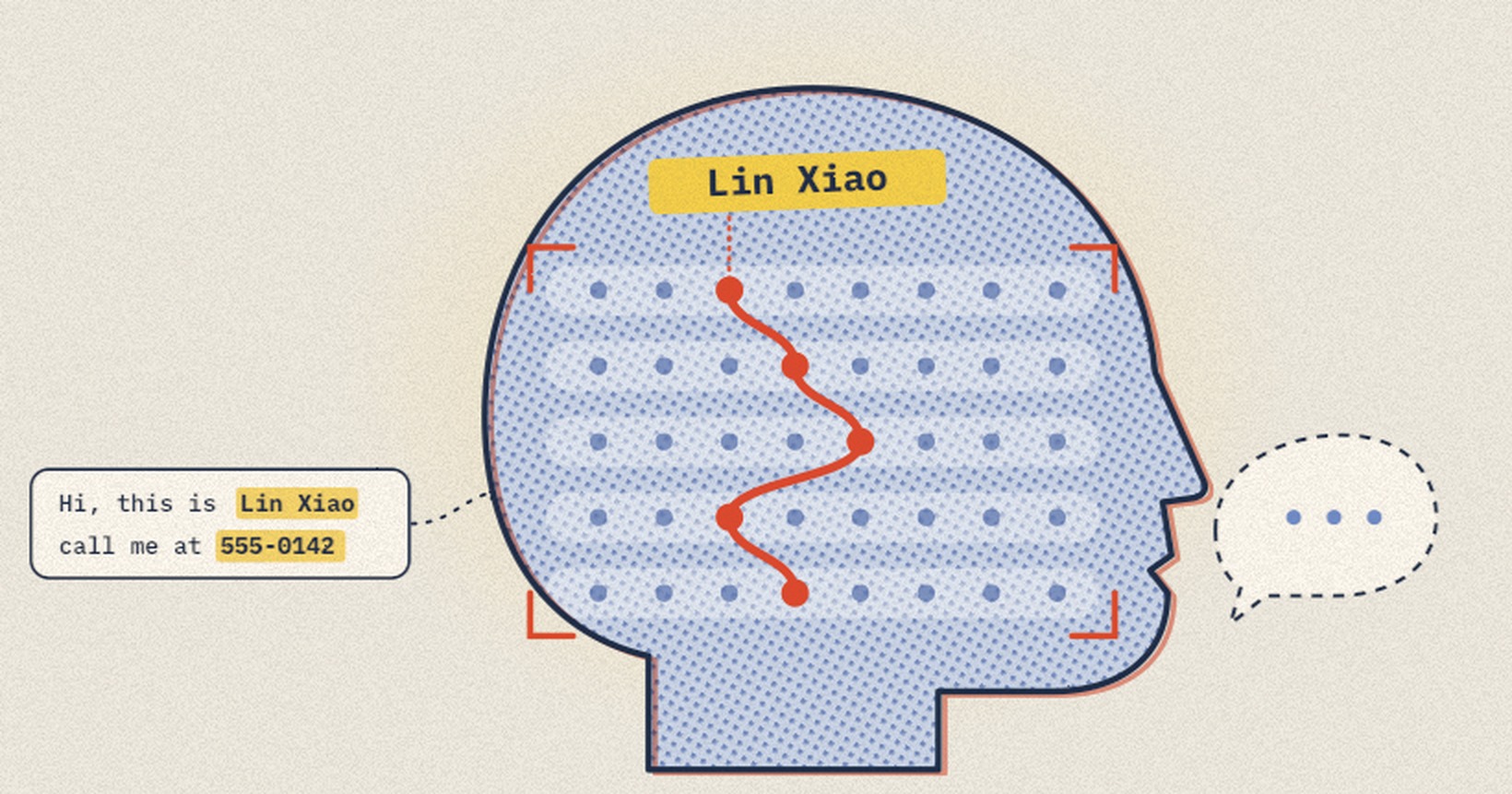
Users’ personal information can be found inside the model before it produces any output. While DeepSeek-V4.1-Flash reads text, we record which experts it activates at each layer, and a linear probe marks names, addresses, phone numbers and email addresses word by word. Names are the hardest of the four because they follow no fixed format; yet even for names it never saw in training, the probe fully marks 0.97 of them, while a method that looks only at the surface form of words manages 0.08. It needs little labeled data, 100 training documents are enough, and moved unchanged to real court judgments, the same probe still finds the names in them.
The readout adds little cost: expert activations are a record the forward pass produces anyway, a few integer expert indices per layer that only need to be saved and take less than one hundredth of the storage of neuron activations (the activation vectors of hidden layers); the model stays frozen, needs no retraining, and no second model has to run. Even reading the text just once, in its normal order, the probe covers 0.95 of unseen names. Recognition happens as the model reads the text, so personal information can be masked before it is written to a log or passed to another system. This also shows that expert activations carry a great deal of information: a few integer indices per layer are enough to read out, linearly, how a word is used in its sentence, and masking the name experts lowers the model’s own confidence that a word is a name, so the model itself uses this information (Section 3). Figure 1 gives an overview of the system: the signal passes through the Signal API to applications such as PII masking and log scrubbing.
1. Introduction
Picture a user asking an online shop’s AI customer-service assistant to change a delivery address. So that the order can be checked, the user types their name, the new address and a phone number into the chat (Figure 2). A few seconds later the assistant replies that the address has been changed. For the user, that is the end of it; but the conversation is saved, to be reviewed for quality, used for troubleshooting and sometimes used to improve the model. The people who read these records have no need to know the user’s name, address or phone number.
The personal information in the conversation should therefore be masked before it is saved. Today this step usually comes after the conversation is over: another safety model1 or a set of matching rules reads the whole conversation again, finds the name, address and phone number, and masks them before it is saved (Figure 2, current practice).
This has two drawbacks. First, it can begin only once the conversation is over, so masking always lags behind it. Second, it adds an inference pass: the customer-service model has already read the text once, and the scan has another model read it again.
We want to fold this step into the reading the model does anyway: while the model reads the message, its internals show which words are the user’s personal information, so that by the time the reply is written, what is saved is already masked (Figure 2, ours).
Our approach is to read the model’s own expert activations. All experiments use DeepSeek-V4.1-Flash2, a mixture-of-experts (MoE) model: for each word it reads, only a few experts are activated at each layer. Which experts are activated is a record the model produces anyway while it runs, and the deployer can read it without modifying the model. We train linear probes on this record to test whether, while reading text, the model internally recognizes which words are the user’s personal information.
This record carries far more information than its size suggests. The results show that a few integer indices per layer are enough to read out, linearly, the role a word plays in its sentence: the same word activates different experts when it is used as a name and when it is an ordinary word, and masking the experts that names activate most often lowers the model’s own confidence that a word is a name. Expert selection is usually seen as a mechanism for allocating computation; it is also a representation worth studying in its own right.
2. Method
The method has four steps (Figure 3): input text, read the expert activations of the frozen model, train a probe on labeled data, and read out personal information on text not seen in training.
2.1 Object of observation: expert activations
An MoE layer contains many experts, each of which is a group of neurons, that is, a small feed-forward network. For every token, a gating network scores all experts, and only the few with the highest scores are activated and take part in the computation2. In the MoE literature this step is called routing. We do not use the values of the neurons inside the experts and record only which experts are activated: the indices of the experts activated for a token at all layers together form that token’s expert activation pattern (Figure 4).
Compared with neuron activations, expert activations are simpler to store and to read. Reading neuron activations means exporting the hidden state at every layer: for each token, a vector of thousands of floating-point numbers, multiplied by the number of layers, copied out of GPU memory as it is read. Expert activations are only the integer indices of the few experts activated at each layer, one or two bytes per index, so the record of a token takes less than one hundredth of the space. The gating network computes these indices during the forward pass anyway; they only need to be saved, can be written to a log token by token during generation, and remain available afterwards. The experiments below show that, although they record only which experts are activated, these indices reflect how the model interprets the current token.
2.2 Readout method: probes
To test whether the expert activation pattern carries a given piece of information, we train probes: small classifiers that take the expert activation pattern as input and output the property to be read. Here the probe decides for each word whether it belongs to a type of personal information: a name, an address, a phone number or an email address.
Probes are trained on labeled data and tested on data not seen in training (Figure 5). They are kept simple by design: a linear classifier. The simpler the probe, the stronger the evidence that the information it reads out is already present in the expert activations and was not learned by the probe itself. Table 1 summarizes the data, probe and evaluation.
Table 1Experimental setup
| Research question | Whether expert activations identify personal information in text, names in particular |
| Training data | Synthetic Nemotron-PII data: 4,000 documents, about 860,000 tokens3 |
| Probe | Linear classifier, one decision per word |
| Evaluation | Unseen domains and names; real court judgments; other languages |
| Intervention | Mask the experts most strongly associated with names |
2.3 Reading out the signal: reading modes and metrics
Step 4 of the method is the readout: the trained probe is applied to text not seen in training and marks the personal information in it word by word (Figure 6). The probe reads expert activations in one of two ways. The first is a single pass, in which the text is read once in the model’s usual order. The second is called rereading. Because the model reads from left to right, it has not yet seen what follows a word when it reaches that word; when the whole text is fed in twice and read from the second copy, which experts each word activates depends on the full context. Section 3.2 analyzes the effect of rereading in detail.
As a control, we train a second classifier that sees only the surface form of words: its input is the current word and its left and right neighbors, without expert activations. We refer to it as the surface-only baseline. The probe likewise reads the expert activations of the current word and its two neighbors, so the two see the same span and differ only in what they read there. A second control is a set of regular expressions that match only email addresses and phone numbers.
Three metrics are used: entity F1 measures whether the personal information found is complete and assigned the correct type; unseen-name coverage considers only names that never occur in training and is the fraction of them in which every non-whitespace character is redacted; the over-redaction rate is the fraction of ordinary text that is wrongly redacted as personal information.
3. Evidence: name signals inside the model
Of the four types of personal information, phone numbers and email addresses follow fixed formats and can be matched with regular expressions. Names are different: any combination of characters can be a name, new names keep appearing, and many names are spelled the same as ordinary words; in our tests, regular expressions that match only email addresses and phone numbers find no names at all. The evidence in this section therefore concentrates on names and addresses five questions in turn: whether the probe merely memorizes a list of names (Section 3.1); whether it relies on the word itself or on how the word is used in its sentence (Section 3.2); in which layers of the model name information sits (Section 3.3); whether the model itself uses these signals (Section 3.4); and whether the probe still works on text beyond the training distribution (Section 3.5).
3.1 Generalization to unseen names
An obvious concern is that the probe may simply memorize the names that appear in its training data. For this reason, many of the names in the test set never occur in training, and this section focuses on how the probe performs on them.
Figure 7 shows the design. The probe is trained on 4,000 synthetic documents to decide, for each word, whether it belongs to a name, an address, a phone number or an email address; the test documents come from domains absent from training.
Figure 8 compares the readouts on unseen domains; the reading modes, metrics and baselines are described in Section 2.3.
For names never seen in training, the probe on expert activations finds 0.97 of them, and 0.95 even when it reads the text only once; the surface-only baseline finds just 0.08. The surface-only baseline recognizes only names it has seen in training, while expert activations remain informative on new names, so what the probe reads is not a memorized list.
In actual redaction, missing a name costs far more than redacting a few extra ordinary words, so a stricter setting is also tested: the threshold is tuned on a development set to 99% coverage and then applied to unseen domains, where we also measure the fraction of ordinary text that is wrongly redacted and the fraction of documents in which no name is missed. To see how much labeled data is needed, the number of training documents is increased from 25 to 3,585, which is all the training documents available for this set of experiments (Figure 9).
With just 100 training documents, the probe’s coverage reaches 0.991, only 1.2% of ordinary text is redacted by mistake, and 98.5% of documents miss no name at all. The surface-only baseline, even when trained on 1,600 documents, reaches a coverage of 0.984 only by redacting 57% of ordinary text, that is, more than half of the text along with the names; with the same 1,600 documents the probe covers 0.990 and redacts only 0.3% of ordinary text by mistake.
3.2 Two uses of the same word
Section 3.1 shows that the probe has not memorized a list of names. Two explanations remain: expert activations may reflect which word is present, or the role the word plays in its sentence. Telling them apart requires the same word to play different roles in different sentences.
To that end, we select a set of words that can be either a name or an ordinary word, place each word at the start of a sentence in each of its two uses, and measure how often the probe classifies it as a name. Hope, for example, is a name in “Hope called me yesterday” and an ordinary word in “Hope is enough.” The words are placed at the start of the sentence because the model reads from left to right: in a single pass, the experts activated for the first word are fixed before the rest of the sentence appears, so the cues that decide its use are not yet visible; with rereading, the whole sentence is already in context, and the judgment can draw on all of it.
Figure 10 shows the result. With rereading, when these words are used as names the probe almost always takes them for names (0.96), and when they are ordinary words it almost never does (0.04). The word and its position are the same and only the context differs, yet the model activates different experts and the probe’s judgment changes accordingly.
What rereading does: left to right, single pass, rereading, the measured result. The animation requires JavaScript.
To check that this is not limited to this set of words, we tested two more sets of words with two uses. In the first, a word is a surname after a title such as Mr. or Ms. and another proper noun when it stands alone; the second consists of words such as May and June, which can be a month or a name. Whenever the context gives a clear cue, the readout from expert activations separates the two uses completely (1.00 vs. 0.00), while the surface-only baseline cannot separate them in any of the three sets (Figure 11). Expert activations thus record not only which word is present but the role it plays in its sentence, and a few expert indices per layer are enough to read this distinction out linearly.
3.3 Distribution of name information across layers
The previous sections show that name information can be read out, but not where in the model it sits: expert activations are spread over dozens of layers, and name information may be concentrated in a few of them or spread across all. Knowing which it is helps in understanding the model and also determines how much data a readout has to store. Figure 12 compares the layers one by one. Name information can be read from layers 1–5, layer 15 and layers 36–39, a U-shaped pattern in which the layers closest to the input and to the output carry the most information. Reading from only 8 of these layers costs little, F1 going from 0.89 to 0.83–0.84, so storing those 8 layers is enough.
Layer 0 provides further evidence: the experts activated for the same word in different sentences overlap by only 6% (Figure 13). If the activated experts depended on the word alone, the same word would activate the same experts in every sentence and the overlap would be 100%; the measured 6% shows that expert activations depend on context from the first layer onward, consistent with Section 3.2: expert selection does more than allocate computation word by word, and it carries contextual information from layer 0 on.
3.4 Expert masking: a causal test of the signal
That a probe can read names from expert activations does not mean the model itself uses this information: the name signal in expert activations could be a by-product that plays no part in the model’s judgment. Testing this requires intervening in the model and observing whether its behavior changes once the signal is removed.
The experiment has three steps (Figure 14). First, on the training data, we count how often each expert is activated by name tokens and take the group that name tokens activate unusually often; these are referred to as the name experts. Second, the name experts are masked at inference by setting their gate bias to −1e9, so that tokens are handled by other experts instead; we verified that the masked experts are never activated afterwards. Third, the model is asked directly, “Is this word in the sentence a name?”, and the difference between the log probabilities of the answers “yes” and “no” is denoted LO. A larger LO means the model is more certain that the word is a name; the change in LO caused by masking is denoted ΔLO.
Even if LO drops, an alternative explanation must still be ruled out: that masking any group of experts disrupts the model. Three controls are used for this purpose:
- No masking: the same sentences are read twice, which gives the natural fluctuation of LO.
- Random experts: the same number of experts drawn from the same layers, activated about as often as the name experts but with no preference for any type of information.
- Address experts: experts that address tokens activate unusually often, chosen with the same procedure as the name experts. Addresses and names are both personal information and are selected in the same way; the only difference is the category the experts favor, so this control tests whether the effect is specific to names.
Masking 8 name experts lowers LO by 0.92 and masking 32 lowers it by 2.92: the more experts are masked, the larger the drop (Figure 15). For comparison, the natural fluctuation of LO without masking is only ±0.08. Masking the same number of random experts produces no such drop, and masking address experts has a much smaller effect (−0.04 for 8, −0.21 for 32). The drop therefore comes from the name experts themselves and not from a general disruption caused by masking. Moreover, on sentences in which the word has its ordinary use, masking the name experts does not produce the same drop (Figure 15); the effect appears only when the word is used as a name.
Masking these experts changes the model’s confidence when it judges names, not its overall capability. After 32 name experts are masked, the model’s confidence drops substantially, but its accuracy changes only from 0.996 to 0.984, and on 40 general-purpose documents the language-modeling loss is almost unchanged (+0.002). The model therefore uses these experts to judge names but does not depend on them alone: once they are masked, backup experts take over the function, and the model’s other capabilities are unaffected.
3.5 Generalization beyond the training distribution
All data used so far for training and testing are synthetic. To test whether the probe is equally effective on other text, this section applies the same probe, without any adjustment, to three new kinds of text (Figure 16): real court judgments (the TAB dataset4, with titles such as Mr and Ms removed so that the probe cannot rely on them); documents produced by a different synthetic-data generator, Ai4Privacy5; and text in German, French, Spanish, Italian and Dutch, although the probe is trained on English only.
Moved unchanged to real court judgments, the probe fully covers 0.948 of the names with rereading and 0.975 with a single pass, both above the 0.903 reached by simply prompting DeepSeek to find the names, while the surface-only baseline finds almost none (0.006). On documents written by another generator, Ai4Privacy, and at the high-coverage threshold of Section 3.1, the probe still reaches a coverage of 0.88, and 0.935 once regular expressions for email addresses and phone numbers are added, while redacting 4.9%–5.8% of ordinary text by mistake; its entity F1 is 0.52, more than ten times the surface-only baseline (0.04). Trained on English only and used directly on German, French, Spanish, Italian and Dutch, it reaches an F1 of 0.46–0.52, while the surface-only baseline stays near 0.02.
4. Conclusion
This work reads users’ personal information from the expert activations of DeepSeek: before the model produces any output, a linear probe marks names, addresses, phone numbers and email addresses, and finds 0.97 of the names it never saw in training. Control experiments show that the probe relies on how a word is used in its sentence, and the masking intervention shows that the model itself uses these signals. Because the readout needs only the expert activations the model produces anyway, privacy protection can happen while the model reads the text, rather than after the output is complete and has been passed to another model for checking. These results also show that expert selection, which seems merely to allocate computation, is itself a representation rich in information: a few integer indices per layer are enough to read out, linearly, the role of a word in its context, and the model uses it causally, which makes expert activations worth studying for interpretability.
Citation
@misc{deepseek_blackbox2026,
  title  = {Before the Model Speaks, We Read Privacy Risk: Reading Privacy Signals of Personal Names},
  note   = {Open DeepSeek’s Black Box series},
  author = {{SeedSky Team}},
  year   = {2026},
  url    = {https://seedsky.ai/papers/open-the-black-box/}
}
References
- Granite Guardian: Comprehensive LLM Safeguarding. NAACL 2025 Industry Track.
- DeepSeek-V4.1-Flash: Pushing the Limits of KV Cache Compression. DeepSeek-AI, 2026.
- Nemotron-PII: Synthesized Data for Privacy-Preserving AI. NVIDIA, 2025.
- The Text Anonymization Benchmark (TAB): A Dedicated Corpus and Evaluation Framework for Text Anonymization. Computational Linguistics, 2022.
- PII Masking Datasets. Ai4Privacy, Hugging Face.